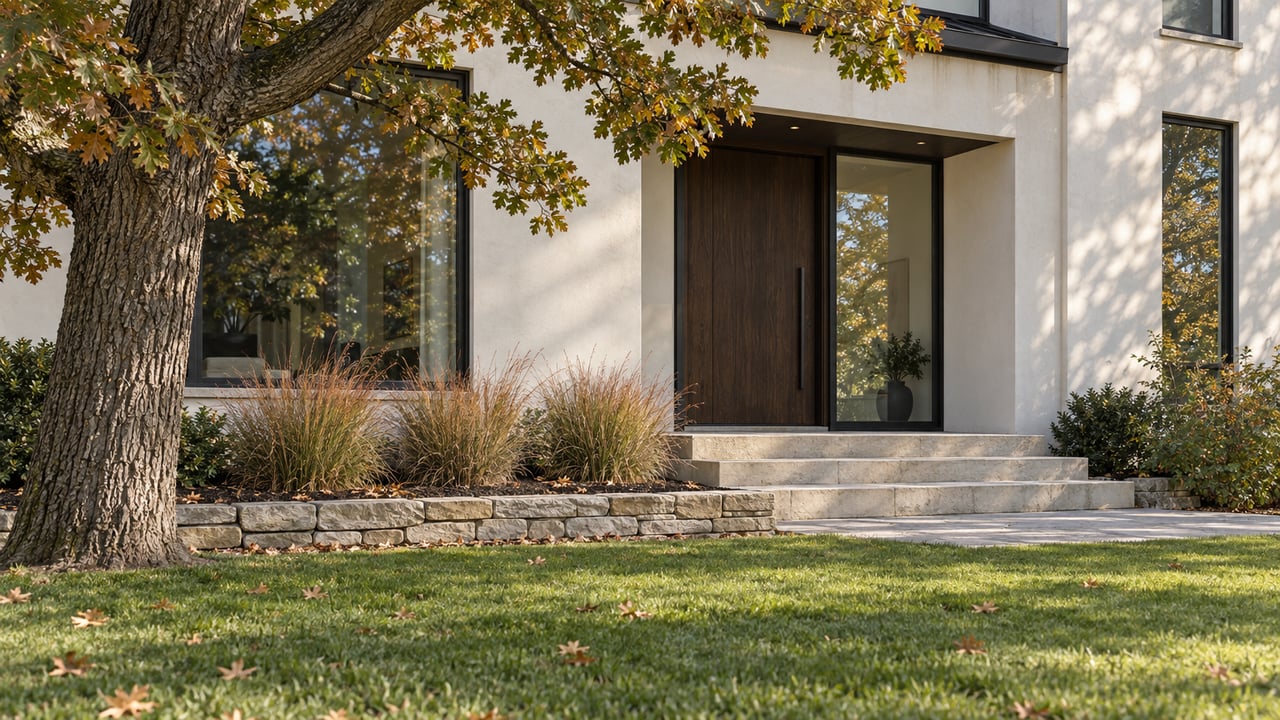
The Owl Deciding Which Quincy Farm Trail Loop Is Open This Fall
October 1, 2026
October 1, 2026
"Quincy Farm reminds us of the simple joy of being outdoors in a place that feels timeless." That's how the nonprofit running the Farm's programming describes it on its own site, and for most of the years Cherry Hills Village residents have lived alongside the property, timeless has mostly meant untouched. You could see the pastures from the High Line Canal bridge at Quincy Avenue. You could not do much else.
That changed this year, and the thing that changed it is not a ribbon-cutting or a press release. It's a pair of capital projects that finally landed in the same season, and a nesting box in the northwest corner of a pasture that, more than any city ordinance, decides how far you can actually walk.
Quincy Farm's west side has a nature trail built in two separate phases, and the reason for the split is a family of great-horned owls that nests in a box along Quincy Avenue. Phase one, a loop that runs from the driveway across the bluegrass lawn and into the pastures, was finished in March 2024. It was designed to stay clear of the nesting box entirely, which is why it opened without waiting on the birds.
Phase two is different. That loop crosses the northwest corner of the pastures, close enough to the box that the City held off on building it until after that year's nesting season ended, and the loop still observes seasonal closures now that it exists. In practice, that means the map of what's walkable at Quincy Farm isn't fixed. It shifts with the owls every year, not with a posted city calendar. If you haven't checked which loop is open since your last visit, you're working from an outdated picture, and the outdated picture isn't a minor gap. It's the difference between a short out-and-back and the full two-loop walk.
The owl schedule is the recurring variable. The bigger story this fall is that two multi-year projects both wrapped, and this is the first season Cherry Hills Village residents can walk the results of both at once.
The Big Barn, the center-aisle structure built in 1934 under original owner Myron Blackmer, went through a full rehabilitation that started in late summer or early fall of 2024. The east-side barnyard closed for about a week starting October 24, 2024, for the trenching work that laid new electrical and water lines. By the following June, the project was done, and the Farm marked it with a Grand Reopening. It's the same barn that anchors nearly every education program and gathering held on site, restored rather than replaced, with the original horse stalls kept intact.
The second project sat right next to it, literally. The Farm's irrigation pond, fed by the High Line Canal and visited by herons, hawks, and other wildlife for decades, was shallow and had poor water quality for years. A $241,000 grant from Arapahoe County Open Space paid for a full restoration: the pond was dredged and aerated, invasive plants were pulled, more than 100 trees and shrubs went into the ground, and split-rail fencing now protects the more sensitive areas. Bird houses, habitat logs, a bat box, and floating islands were added on top of that. Arapahoe County's own account of the project describes the pond as having "recently been revitalized," and the scope matches what the restoration contractor documented on site.
Two projects, one barn and one pond, both closed out within roughly a year of each other. That overlap is why this fall reads differently than the last several. It's the first one where the barn is finished, the pond is finished, and both are open to see rather than fenced off behind construction signage.
None of that would matter much if nobody used it, so it's worth pointing out that people already are. The Farm's own recap of last season counted more than 1,600 visitors across its family programs, adult workshops, and speaker events, a jump the nonprofit credits partly to the newly reopened barn giving them a real indoor gathering space for the first time. This year's Barn Party, the annual evening fundraiser that's become the closest thing Quincy Farm has to a signature event, was held on Friday, September 18, at the Big Barn itself.
The party is a fundraiser for Cherry Hills Land Preserve, the local nonprofit that's partnered with the City since late 2021 to bring the property back to life. That partnership matters for context. The land was donated to the City by its previous owner, Catherine "Cat" Anderson, under a conservation easement that protects the pastures, the century-old trees, and the 1898 farmhouse the Hopkins family originally built, still the oldest and most intact farmhouse standing in Cherry Hills Village. For years after the gift, the City and CHLP spent time figuring out how to actually open the place to residents without undoing the very thing the easement was written to protect. The Farm's own materials describe that period plainly as long-dormant. This fall is the clearest evidence yet that dormant is no longer the right word.
Quincy Farm runs on a different rule set than most of the rest of Cherry Hills Village's trail network, and a few of those rules catch people off guard.
None of these are new this year. What's new is that with both trail loops closer to fully open and the barn back in regular use, more residents are likely to actually encounter them for the first time.
Quincy Farm sits on both sides of the High Line Canal, with the east side addressed at 4450 E. Quincy Ave. and the west side at 4400 E. Quincy Ave. Both sides are open from sunrise to sunset every day of the year. The most direct approach is on foot or by bike along the Canal trail itself, crossing the bridge at Quincy Avenue, or by walking up the bike path along Quincy Avenue from either direction. Parking is minimal by design: the east side has exactly one accessible space and nothing else, and the west side has none at all. This is a walk-in or ride-in property, which fits its footprint in the city's open space inventory. At 17.5 acres, Quincy Farm accounts for roughly a quarter of all the public open space and parkland Cherry Hills Village maintains, a notable share for a single property in a city built around large private lots rather than public acreage.
The owl box in the northwest pasture doesn't check a calendar posted at City Hall. It nests when it nests, and the trail loop around it opens and closes on that schedule rather than anyone else's. That's a small detail to build a fall walk around, but it's also the most honest way to describe what Quincy Farm actually is right now: a restored barn, a rebuilt pond, and a trail map that a family of owls still gets a vote on.
If you're weighing what a property like Quincy Farm's conservation easement means for a home near it, or you're simply curious how projects like this shape daily life in Cherry Hills Village, Makin' Moves with Georgia is always glad to talk through it over coffee, no agenda required.
This article is general information, not legal, tax or financial advice. Consult a qualified professional about your situation.
October 22, 2026
October 15, 2026
October 8, 2026
October 1, 2026
September 24, 2026
September 17, 2026

September 10, 2026

September 3, 2026

August 27, 2026
Georgia combines tenacity, warmth, and integrity with deep market insight and strong negotiation skills, enabling her to advocate effectively for every client. Whatever your real estate goals, she is dedicated to helping make them a reality.
44 COOK ST DENVER CO 80206